
United States Constitutions - Federal & State, U.S. Constitution, Case Law - General & Miscellaneous
Log in to track your reading progress.
Overview
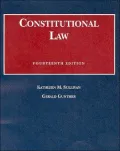
The 13th edition of Constitutional Law maintains the structure of recent editions while thoroughly streamlining material and updating the cases covered. In addition, for the first time, a detailed Teacher's Manual has been prepared to assist current and new users in understanding the breadth and depth of this leading publication.Important features:
- Federalism - The latest decisions on clashes between federal and state authority, including Lopez, NY v. U.S., Term Limits, and Seminole Tribe
- Equal Protection - Updated focus on current controversies over affirmative action and voting rights
- Free Speech - Current controversies from indecent speech on the Internet to proposed regulations of tobacco advertising and campaign money
- Religion - The constitutionality and Interpretation of the Religious Freedom Restoration Act, and debates over the meaning of religious liberty
Editorials
Joseph F. Kobylka
Gerald Gunther's CONSTITUTIONAL LAW is a "venerable" text. I became aware of it as an undergraduate in the 1970s, but Gunther's association with it dates back to 1965. This durability is impressive, but still more so is the fact that his first edition of this case law text was ITS seventh; it was first issued in 1937 by Noel T. Dowling, a professor of law at Columbia University. Thus, students of constitutional law have been using this volume, in one incarnation or another, for over 55 years! Surely something that has survived the vagaries of the publishing world this long is doing something right, and this volume provides an impressive overview of much of the legal literature on the cavernous subject matter of "Constitutional Law." Evaluating a case law reader is a difficult task. Different people teach this material in different ways and, as such, any evaluation will be prejudiced by two sets of competing preferences: those of the book's user, and those of its editor/author. Although I try to separate MY instructional taste, style, and emphasis from this discussion, what follows is undoubtedly influenced by the way I approach teaching law-based classes. Indeed, while I would not adopt Gunther's volume as required reading for my classes, Foundation Press's advertisements note that it has been adopted in over 200 schools. Given its many virtues, this is not surprising. What keeps me from joining my colleagues in their decision is the essentially legalistic structure of the work, a structure that too frequently obscures the extent of the political nature of the Court in the American system of governance. In the "Preface to the Ninth Edition," reprinted here, Gunther writes that there are three ways to structure a constitutional law text -- traditional, historical, and methodological -- and that each approach has its own utility. He opts forBook Details
Published
January 1, 1997
Publisher
Foundation Press
Pages
1500
Format
Hardcover, 2000
ISBN
9781566629072