
Fiction - Historical Fiction, Fiction - Nature, Fiction - Asian People, Places & Cultures, Fiction - General & Miscellaneous, Fiction - U. S. People, Places & Cultures
Log in to track your reading progress.
Overview
This morning the earth shook
and threw us from our beds.
We were not hurt, just stunned.
Drawers spilled, dishes crashed,
pots and pans clanged as
they fell.
Ancestral portraits flew off
the walls.
Milly Lee's mother was eight years old in 1906, when San Francisco was shaken by a powerful earthquake. Buildings fell, fires flared, and the city burned for several days.
This is the stirring story of one Chinese American family who had to leave their home in Chinatown on that early morning to join hundreds of other refugees making their way to safety.
A young Chinese-American girl and her family move their belongings from their home in Chinatown to the safety of Golden Gate Park during the San Francisco earthquake of 1906.
Editorials
Publishers Weekly
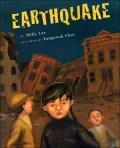
Curiously quiet and flat by contrast to Lee and Choi's previous collaboration, Nim and the War Effort, this story is based on the experience of Lee's mother who, as a child, survived the 1906 San Francisco earthquake. "This morning the earth shook/ and threw us from our beds./ We were not hurt, just stunned," opens the forthright first-person account. The narrator and her family then pack up their belongings and transport them by cart from Chinatown to Golden Gate Park, which served as a refuge for people whose homes were destroyed by the quake. An aftershock brings the sole interruption to the tedium of the trip, and this moment's excitement is conveyed more effectively by the artwork than the textAa sky ablaze with flames provides the backdrop to the terrified faces of the characters. Throughout, Choi's earth-toned, shadowy paintings propel the tale with expressive faces, period dress and views of a blossoming city ravaged by a natural disaster. The volume ends rather anticlimactically with the family still camped out in the park; only an endnote states that the family moved to Oakland temporarily while San Francisco was rebuilt. Ages 4-8. (Aug.) Copyright 2001 Cahners Business Information.Publishers Weekly
This story was inspired by Lee's mother who, as a child, survived the 1906 San Francisco earthquake. In PW's words, "Choi's earth-toned, shadowy paintings propel the tale with expressive faces, period dress and views of a blossoming city ravaged by disaster." Ages 4-8. (Mar.) Copyright 2006 Reed Business Information.Children's Literature
The author has based this story of the survival of a Chinese-American family in the 1906 San Francisco earthquake on her mother's experience. In simple, brief sentences she describes the events beginning with the initial shock. Chinatown families pack belongings and are told to move to Golden Gate Park as fires rage, buildings crumble and they struggle through frightened throngs to the comparative haven of food and shelter in tents. Choi's controlled palette of somber browns and umbers, with only the glowing yellow-oranges of the fire to add a horrifying contrast, sets the emotional tone for this drama. Her broad brushstrokes create paintings that emphasize the shapes of buildings and the action of harried people. For all of the implied tragedy, however, the solidity of her figures and the lack of frenzy suggest the relatively happy ending. The author has added notes about the factual background. 2001, Frances Foster Books/Farrar Straus and Giroux, $16.00. Ages 4 to 8. Reviewer: Ken Marantz and Sylvia MarantzSchool Library Journal
K-Gr 2-This narrative follows a child and her family from their severely damaged home in Chinatown to the relative safety of Golden Gate Park on the day of the 1906 San Francisco earthquake. Unfortunately, most of the dramatic tension such a day would engender has been lost in overly cautious prose. The concluding author's note is far more interesting. It contains fascinating details (the mother and grandmother had bound feet, which hindered their progress to safety) and factual information (the original death count excluded women and children, Native Americans, African Americans, and Japanese and Chinese immigrants because they were not on the books as voters or property owners). Illustrations utilize a somber palette of browns and grays. The buildings of the city will be disappointing to readers who are familiar with San Francisco because they lack the distinctive and recognizable style of the city's architecture. Named sites, such as Portsmouth Square, lack identifying characteristics, rendering the art generic rather than site specific. Even the figures seem generic, devoid of individual personalities. Although this story is based on the author's mother's experience, it lacks the spark of life.-Dorian Chong, School of Library and Information Science, San Jose State University, CA Copyright 2001 Cahners Business Information.Kirkus Reviews
Early on the morning of April 18, 1906, an earthquake shook the city of San Francisco, collapsing buildings and igniting fires that raged for days. In the straightforward words of the girl who was her mother, Lee (Nim and the War Effort, 1997) tells the story. Her family-grandmother, parents, and brothers-were thrown from their beds in San Francisco's Chinatown that morning, and quickly packed not only food and clothing but also the precious portraits of their ancestors and the statue of the Goddess of Mercy Kwan Yin. They loaded a cart and pushed and pulled it through the city to Golden Gate Park. (Lee explains that the bound feet of mother and grandmother made it impossible for them to walk very far.) There, from tents, they watched the city burn. The illustrations' sculptured forms and geometric shapes make a pattern of stability against dark vistas of smoke, fire, and destruction. The strength of the figures stands in contrast to the fear and hunger the child describes, enabling young readers to take in the scene and still find reassurance and comfort. A good way to introduce the youngest of readers to a calamitous event. (author's note) (Picture book. 5-8)Book Details
Published
February 21, 2006
Publisher
Farrar Straus Giroux
Pages
32
Format
Paperback
ISBN
9780374419462