
Humanism
Available on Bookshop
Write a review
Books.org participates in affiliate programs including Bookshop.org and the Amazon Services LLC Associates Program. We may earn a commission from qualifying purchases made through links on this page, at no additional cost to you.
Log in to track your reading progress.
Overview
An argument that achieving millennial life spans or monumental intellects will destroy values that give meaning to human lives.Synopsis
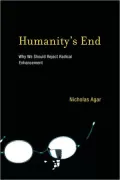
An argument that achieving millennial life spans or monumental intellects will destroy values that give meaning to human lives. Proposals to make us smarter than the greatest geniuses or to add thousands of years to our life spans seem fit only for the spam folder or trash can. And yet this is what contemporary advocates of radical enhancement offer in all seriousness. They present a variety of technologies and therapies that will expand our capacities far beyond what is currently possible for human beings. In Humanity's End, Nicholas Agar argues against radical enhancement, describing its destructive consequences. Agar examines the proposals of four prominent radical enhancers: Ray Kurzweil, who argues that technology will enable our escape from human biology; Aubrey de Grey, who calls for anti-aging therapies that will achieve “longevity escape velocity”; Nick Bostrom, who defends the morality and rationality of enhancement; and James Hughes, who envisions a harmonious democracy of the enhanced and the unenhanced. Agar argues that the outcomes of radical enhancement could be darker than the rosy futures described by these thinkers. The most dramatic means of enhancing our cognitive powers could in fact kill us; the radical extension of our life span could eliminate experiences of great value from our lives; and a situation in which some humans are radically enhanced and others are not could lead to tyranny of posthumans over humans.Editorials
From the Publisher
"Penetrating and lucid….This is the definitive critique of what [Agar] calls'radical enhancement.'" — Monash Bioethic Review"An evenhanded treatment of an area ripe for serious philosophical scrutiny. Agar's analysis is philosophically astute, empirically informed, and historically shrewd. It is a welcome corrective to the occasional extravagancies of the human sciences." — Quarterly Review of Biology
Book Details
Published
October 18, 2010
Publisher
MIT Press
Pages
232
ISBN
9780262288934