
Time & Money, Children - Learning Basic Concepts, Children - Science & Technology, Mathematics, Mathematics, Macroeconomics
Available on Bookshop
Write a review
Books.org participates in affiliate programs including Bookshop.org and the Amazon Services LLC Associates Program. We may earn a commission from qualifying purchases made through links on this page, at no additional cost to you.
Log in to track your reading progress.
Editorials
Children's Literature -
Children know about money from the time they are small, but may not understand many of the basic concepts about cash. In this introduction to American currency, author Rebecca Wingard-Nelson narrows her focus to the essentials: how people earn money, what money can be used for, what coins and bills are made from, and what each is worth. The images of the various bills and coins are large enough to use as discussion prompts if a teacher wants to delve into the history of the people and symbols depicted. In at least one case, however, the coin illustrated is not the most recently issued design. Denominations of bills higher than one dollar do not receive individual spreads, in keeping with the target audience's age and abilities. One spread on money combinations introduces the concept of adding different types of coins and dollars. With an index, table of contents, additional resources page, and review section, this colorful nonfiction book for young readers adequately takes an abstract concept and focuses on the most concrete aspects of it in order to make it accessible to young minds. Reviewer: Keri Collins LewisChildren's Literature -
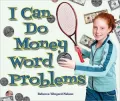
The "I Like Money Math!" series shows the middle reader how to identify, count, add, and subtract money. The book format is as much visual as it is textual. A straightforward presentation of the basics of money and math gives the young reader an essential grasp on the real world of math. This book assumes that a reader already knows how to county, add, and subtract money. Such knowledge is applied to real life situations, known as word problems in school. The process of solving word problems has four steps. Step 1 is to read the problem. Step 2 is to plan to solve the problem. Step 3 is to follow the plan. Step 4 is to check your work. The reader is taken through this process to solve several real life situations. The first example requires addition as Ben finds a quarter to add to the 50? he already has. Next, one must subtract to find out how much money Sienna has after buying her school lunch. Counting is required to determine whether Trina or Annie has more money. Two more problems ask the reader to figure out if Barack and Emily have enough money to buy what they want. Finally, the important problems of counting change are demonstrated. All of these examples are quite relevant to today's children, as they are given responsibilities such as buying lunch or selling lemonade. There are references to books and websites, plus an index. Practice worksheets are online. Reviewer: Carol Raker Collins, Ph.D.Book Details
Published
November 1, 2009
Publisher
Enslow Publishers, Incorporated
Pages
24
Format
Paperback
ISBN
9780766036598