
Asia - Civilization, Indian History - Republic of India (1947-Present)
Log in to track your reading progress.
Overview
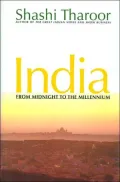
Shashi Tharoor's India: From Midnight to the Millennium is a portrait of one of the world's most important and interesting countries - its politics, its mentality, and its cultural riches. But it is also an eloquent argument for the importance of India to the future of America and the industrialized world. Shashi Tharoor shows that India, is it prepares to celebrate the fiftieth anniversary of its political independence, stands at the intersection of the most significant questions facing the world at the end of the twentieth century. If democracy leads to inefficient political infighting, should it be sacrificed in the interest of economic well-being? Should the developing world opt for bread over freedom? Does religious fundamentalism provide a way for Third World countries to assert their identity in the face of Western hegemony, or is there a case for pluralism and diversity amid cultural and religious traditions? Does the entry of Western consumer goods threaten a country's economic self-sufficiency, and is protectionism the only guarantee of independence? The answers to such questions will determine what kind of world the next century will bring. And since Indians will soon account for a sixth of the world's population, their choices will resonate throughout the globe.Editorials
Publishers Weekly -
This year, India, whose population is expected to overtake China's within three decades, which will make it the largest country in the world, celebrates the 50th anniversary of its independence from British rule. Tharoor (The Great Indian Novel) offers here the perspective of an Indian who has spent much of his life abroad, in recent years as a senior official at the United Nations. Indeed, his take is multi-layered, because he describes as well what it is like to be a native of the southern Indian state of Kerala, whose language, Malayalam, he and his family do not even speak fluently. The narrative presents colorful stories of village life, ruminations on the Hindu religion, accounts of political turmoil and upheaval as well as of the author's own experiences as an expatriate. If there is a villain in this book, it is former Prime Minister Indira Gandhi, who invoked a state of emergency in 1971 and suspended certain constitutional rights. Whereas many in the West viewed her as the tough daughter of founding father Nehru who successfully prosecuted the war against Pakistan and sundered that nation in the process, Tharoor portrays her as "skilled at the acquisition and maintenance of power, but hopeless at... wielding... it for larger purposes." He also accuses her of relying too much on her sons, Sanjay and Rajiv, to govern the country. Readers with an interest in the history of the subcontinent will find this a literate and affecting panorama of the world's largest democracy.Library Journal
Tharoor, an Indian diplomat, offers "an insightful and provocative analysis of the accomplishments and failures of the past 50 years" that will be "useful to anyone interested in modern India." (LJ 6/15/97)Booknews
Whether or not one agrees with one historian's assessment of India as "the most important country for the future of the world," it is a land of fascinating cultural and political paradoxes<-->here portrayed by Tharoor, executive assistant to the secretary general of the UN, on the cusp of its 50th anniversary as a democratic nation groping toward "a future without shock." Annotation c. by Book News, Inc., Portland, Or.Book Details
Published
August 1, 1997
Publisher
Arcade
Pages
256
Format
Hardcover
ISBN
9781559703840