
Cultural Issues, Asians & Asian Americans
Available on Bookshop
Write a review
Books.org participates in affiliate programs including Bookshop.org and the Amazon Services LLC Associates Program. We may earn a commission from qualifying purchases made through links on this page, at no additional cost to you.
Log in to track your reading progress.
Editorials
Children's Literature
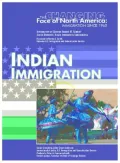
This volume is part of a series titled "The Changing Face of North America: Immigration Since 1965." Other series titles include Cuban Immigration, Deported Aliens, and Immigration from the Middle East. It is worth noting that each book contains an introduction by Senator Edward Kennedy, and forewords by representatives of the United States and Canadian governments. Does this mean the books spout the official line, rather than offering more balanced summaries by, say, unaffiliated social historians? It's hard to say. Certainly it appears evident that the American foreword stresses assimilation, the Canadian one diversity. The text of the book strives to pack an enormous amount of information into 112 pages. In addition to the commonly known historical accounts of early Indian influence in North America (Swami Vivekananda, Maharishi Mahesh Yogi) the book offers notes on more obscure figures (e.g., children's writer and 1928 Newbery winner Dhan Gopal Mukerji, and early Indian immigrants to Canada). And while the author does not shy away from difficult subjects such as communal tensions in India, the book is also careful to portray the positive impact that Indian-born professionals have made on American technology and job creation. Chapters include an introductory one on Indians in North America, followed by material on independence, immigration patterns to North America over the years, making a new life, keeping the culture alive, human smuggling and exploitation, and future immigration projections. Backmatter consists of a list of famous Indian Americans and Canadians, a glossary, reading list, Internet resources, index, picture credits, and a list of distinguished and expertcontributors. A few errors will feel glaring to the knowledgeable reader and misinform the newcomer to this material. Saris, it is erroneously stated on page 76, are worn with a dupatta, a scarf draped over the shoulder. If, as the photo caption suggests she should, a woman added a jacket and salwar to complete her outfit, she would be overdressed indeed! And Diwali does mark the New Year in some Hindu communities, but not in all. Making pan-Indian generalizations from limited information leads to errors that might have been avoided, had someone with specific knowledge of the region been consulted for this book. A pity, because there is a great deal of good information here, and without the mistakes, this could be a useful volume for a middle school reference library. 2004, Mason Crest Publishers, Ages 12 up.—Uma Krishnaswami
School Library Journal
Gr 6-10-These titles focus on immigration to the U.S. and, to a lesser extent, Canada, since the 1960s. They cover reasons for emigrating, U.S. and Canadian immigration policy (identical in each book), the groups' settling in and then working to keep their culture alive, problems (illegal border crossings, human smuggling), and the outlook for future immigration. Boxes and appendixes provide expanded coverage on individuals, history, and current policies. The clearly written texts are broken up by full-color or archival black-and-white photographs, as well as by several bar graphs. Unfortunately, some details are incorrect or sloppy. The title of one graph in Mexican Immigration is missing a word, thus making no sense; another has omitted the bar for 1960s immigration and gives a figure for the 1970s at variance with one elsewhere in the text. Independence Day commemorates an 1810, not 1821, date. Indian Immigration shows astronaut Kalpana Chawla as still alive, with no mention of her death February 1, 2003, in the Columbia space shuttle disaster. Cultural details are occasionally incorrect: ahimsa is misspelled as ashimsa; chai is the Hindi word for tea and not specific to heavily spiced tea; a sari, always made out of six or nine yards of fabric, is not worn with a dupatta. These errors are unfortunate, as these books would otherwise be adequate for reports.-Diane S. Marton, Arlington County Library, VA Copyright 2004 Reed Business Information.Book Details
Published
September 14, 2007
Publisher
Mason Crest Publishers
Pages
112
Format
Binding
ISBN
9781590846834