
Teen Fiction - Body, Mind & Health, Teen Fiction - Family & Relationships, Teen Fiction - Mysteries & Thrillers
Log in to track your reading progress.
Overview
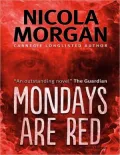
Mondays Are Red was the acclaimed debut of award-winning author, Nicola Morgan. This new edition brings Mondays Are Red to a new audience, and contains interesting extra material, including creative writing by school pupils.The Guardian: “An outstanding novel that rewards rereading.”
The Sunday Herald: “This is a stunning, extraordinary debut.”
The Scotsman: “…extremely impressive debut.”
The Sunday Telegraph: “…oddly brilliant.”
The Observer: among the “Best 0f 2002″.
The Independent, Nicholas Tucker: “… a novel to brood over, written by a new and original talent.”
Books magazine: “A chilling modern take on the Faust story by a stunning new literary talent. … A really unusual children’s book.”
When he wakes up from a coma after having meningitis, fourteen-year-old Luke finds that he has lost control of his senses and his thoughts and he must fight an inner demon in order to return to his former life.
Editorials
Publishers Weekly
Luke Patterson, the 14-year-old narrator of this debut from a British author, wakes up from a bout of meningitis to find his senses jumbled together: "I was seeing music and smelling colors and tasting what my fingers told me." Attempting to convey Luke's synesthesia, Morgan unspools frequently belabored prose ("buttery flute music spread over my face"; "from the ends of my fingers fluttered peppermint butterflies"); even poetry aficionados may grow weary of the heavy-handed narration. Luke also hears a voice in his head, that of the devil Dreeg, who tempts this Faust with the ability to fly-and to take revenge on his hated sister, Laura. Then Luke discovers that his mental powers can shape the outside world: a horror story he writes for a class starts to come true. Before long Laura is facing mortal danger in a climax that, overloaded with dark imagery, feels almost like a reprise of The Texas Chainsaw Massacre. The prose becomes something of a quagmire here, dragging down the characters and the story line, and Morgan's message seems markedly mixed. She paints synesthesia as a nauseating experience-indeed, she never differentiates it from the devil-on-the-shoulder-but goes on in an afterword to wax poetic about the condition as the background to "a life that, it seems to me, must be richer than mine." Ages 12-up. (Oct.) Copyright 2003 Reed Business Information.Children's Literature
After an accident, Luke notices that he associates different things and experiences with different senses (he can taste music and see colors for days). A creature named Dreeg also appears to only him, encouraging angry feelings towards his sister and her boyfriend. Dreeg introduces Luke to a girl that, although Luke is infatuated with her, is of questionable reality. When Luke's sister goes missing, Luke is the only one who can find and help her. Morgan does a wonderful job of writing from the point of view of a person with synesthesia. The lines of reality are blurred in confusing ways at times (why, for example, does the imaginary girl know the name of the condition Luke has if he never heard it before?), but for the most part, it is an intriguing mystery for the reader to solve. Morgan's beautiful language keeps the reader turning the pages as much as the plot. 2003, Delecorte Press, Ages 12 up.— Amie Rose Rotruck
School Library Journal
Gr 8 Up-Luke, 14, wakes up from a meningitis-induced coma to discover he has contracted an unusual condition known as synesthesia in which his senses blur into one another, causing him to associate words and objects through odd juxtapositions of taste, sight, smell, touch, and sound. Even though Luke puts these new associations to good use in his poetry, he imagines himself haunted by a presence he calls "Dreeg," whose influence wavers from good to evil. Through a confused and truly bizarre chain of events, Luke, left physically weak from the coma, semi-deranged from the synesthesia, and under the influence of Dreeg, eventually embarks on a final mission to rescue his sister from a kidnapper. Although at times intriguing, the novel too often has its plot derailed by Morgan's confounding and lengthy hallucinogenic imagery, which is well conceived and sophisticated but doesn't enhance the story's pacing or characterization. The outcome is a confusing, hard-to-follow mystery that will lose most YA readers before they reach the halfway mark.-Hillias J. Martin, New York Public Library Copyright 2003 Reed Business Information.Kirkus Reviews
When 14-year-old Luke wakes up from a life-threatening bout of meningitis, he finds that his perception of the world has changed radically: once ordinary words and concepts are now inextricably associated with colors, sounds, and scents. In addition to synesthesia, however, Luke has gained an interior tenant, a creepy creature named Dreeg who appears to be bent on using Luke to achieve total world domination. This goal seems within reach, given that Luke's new wordsmithing abilities can manipulate reality. Newcomer Morgan vividly exploits the psychedelic possibilities of language made possible by Luke's synesthesia, but finding a plot to hang on all her magnificent imagery proves to be more of a problem. Dreeg uses Luke's fairly ordinary feelings as a scaffold for his ambitions, but just how exactly he happens to be in Luke's head and what the connection is to synesthesia are never made clear to either the reader or Luke. Like a story Luke writes for school, this narrative is more a cool concept than finished plot. A more successful exploration of synesthesia can be found in this year's A Mango-Shaped Space (p. 392). (Fiction. YA)Book Details
Published
December 8, 2011
Publisher
Crabbit Publishing
ISBN
9780957015326