
19th Century British History - Victorian Era (1837-1901), Napoleonic Wars, 18th Century British History - Georgian Era (1715-1837), British Armed Forces - Biography, France - Historical Biography, Great Britain - Army, 19th Century British History - Milit
Log in to track your reading progress.
Overview
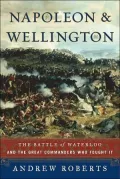
At breakfast on the morning of the battle of Waterloo, the Emperor Napoleon declared that the Duke of Wellington was a bad general, the British were bad soldiers and that France could not fail to win an easy victory. Forever afterwards, historians have accused him of gross overconfidence and massively underestimating the caliber of the British commander opposite him. Now Andrew Roberts presents an original, highly revisionist view of the relationship between the two greatest captains of their age and of the great battle that determined European history in the nineteenth century. Napoleon, who was born in the same year as Wellington -- 1769 -- fought Wellington by proxy years earlier in the Peninsular War, praising his ruthlessness in private while publicly deriding him as a mere "general of sepoys." In contrast, Wellington publicly lauded Napoleon, saying that his presence on a battlefield was worth forty thousand men, but privately he wrote long memoranda lambasting Napoleon's campaigning techniques. Although Wellington saved Napoleon from execution after Waterloo, the emperor left money in his will to the man who had tried to assassinate the duke. Wellington in turn amassed a series of Napoleonic trophies of his great victory, even sleeping with two of the emperor's mistresses. The fascinating, constantly changing relationship between these two historical giants forms the basis of Andrew Roberts's compelling study in pride, rivalry, propaganda, nostalgia and posthumous revenge. It is at once a brilliant work of military history and a triumphant biography. Featuring a cast of fascinating supporting characters -- including the empress Josephine, the Prince Regent and Talleyrand -- Napoleon and Wellington provides the definitive account of the most decisive battle of the nineteenth century.Editorials
Publishers Weekly
Gossipy and anecdotal, at times amusing and at other times enlightening, this book meanders across an era looking for connections between its two greatest generals. British Sunday Telegraph contributor Roberts (Eminent Churchillians) concentrates not on the respective merits of Napoleon and Wellington, but on what they thought, wrote, and said about each other. He spices his text with vignettes such as an extensive description of Napoleon's hemorrhoid problem on the eve of Waterloo, and its successful treatment by the famous surgeon Baron Larrey. Then he demonstrates the relevance of his stories in this case by showing that Napoleon was by no means as debilitated on the day of battle as popular myth accepts. Wellington and Napoleon did not face each other until Waterloo in 1815. Napoleon, who first heard of Wellington in 1808, never showed his great rival quite the respect he deserved, let alone the respect Wellington considered his due, Roberts shows. Though partisans and critics of both men stress their differences, Roberts's text makes a convincing case that Napoleon and Wellington were more alike than either of them would have conceded. Both considered Hannibal their military hero; both carried Julius Caesar's Commentaries in the field. They even shared a couple of mistresses Wellington was at pains to show his post-Waterloo triumph in every way possible. Both were self-confident to the point of arrogance, consciously unemotional and obsessively focused on success. And they spent increasing amounts of time, particularly after 1815, blackguarding each other in the fashion of contemporary professional wrestlers. This history presumes a high level of background knowledge, but readers interested in the rivalries of the period will find it thoroughly absorbing. (Sept. 12) Copyright 2002 Cahners Business Information.Library Journal
Roberts (Eminent Churchillians; Salisbury: Victorian Titan) warns that this book is neither "a joint biography" of Napoleon and Wellington nor "a history of the Peninsular or Napoleonic Wars." Instead, it is a study of the personal relationship between the two men-a study that "concentrates on what each man thought, wrote and said about the other." With a 14-page bibliography of archives, historical works, and articles consulted and 18 pages of notes, it is almost too much of a good thing. Not only are we given Wellington's and Napoleon's recorded thoughts, conversations, and writings about each other (from "First Recognition: 1809-1810" to Waterloo and its aftermath) but we are also presented with various reports of what contemporaries remembered hearing (either firsthand or told by a third person), sometimes several years after the fact. That mild complaint aside, what justifies this work's addition to the ever-growing bibliography for these two historical figures is Roberts's in-depth analysis of "the three battles" in which his two principals were engaged: the battle of Waterloo (a victory for Wellington), the battle of their funerals ("the honours about evenly divided"), and their "third and final battle-the struggle for primacy in their posthumous reputations." This final struggle is still being waged. Recommended for all public libraries and academic libraries as well.-Robert C. Jones, formerly with Central Missouri State Univ., WarrensburgKirkus Reviews
English historian Roberts (Eminent Churchillians, 1995, etc.) delivers a satisfying study of the opposing generals of yesteryear, whose lives intersected in all sorts of odd ways. Napoleon Bonaparte and Arthur Wellesley, the Duke of Wellington, were alike in many respects: both were born in 1769, both lost their fathers early, both had four brothers and three sisters, both changed the spelling of their surnames in adulthood, and both were foreigners, which prompted George Bernard Shaw to quip, "An English army led by an Irish general; that might be a match for a French army led by an Italian general." Moreover, both shared mistresses, grudging admiration and mutual contempt, and an "invincible self-assurance" that sometimes led them to commit grievous errors in the field. Yet their differences, as Roberts effectively demonstrates, were ultimately more important than their similarities: though Napoleon was a brave and resourceful commander, for example, he seems not to have taken into account the immense logistical problems attendant in trying to conquer most of Europe, with the result that he left his troops to maraud for food and drove his horses to death; whereas Wellington, more cautious, managed to bring fresher troops and mounts into the field, if not the legendary glories of his opponent. Roberts capably corrects a few myths as he follows the two generals to their ultimate contest at Waterloo, writing, for instance, that far from disdaining Wellington as an inferior, Napoleon "squeezed people for information about Wellington’s character and interests," denigrating Wellington only after Waterloo in an effort to explain away his defeat; Wellington, for his part, returned thecompliment by, in effect, saving Napoleon’s life at Waterloo—an incident that, as Roberts reports it, will be of considerable interest to students of the battle. The shelves groan complainingly with studies of the Iron Duke and the Little Corporal. Room should be found for this one.Book Details
Published
September 16, 2002
Publisher
New York : Simon & Schuster, 2001.
Pages
384
Format
Hardcover
ISBN
9780743228329