
Mathematics & Measurement, Fiction - Basic Concepts
Available on Bookshop
Write a review
Books.org participates in affiliate programs including Bookshop.org and the Amazon Services LLC Associates Program. We may earn a commission from qualifying purchases made through links on this page, at no additional cost to you.
Log in to track your reading progress.
Editorials
School Library Journal
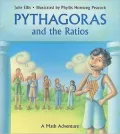
Gr 4–7—This picture-book introduction to ratio and proportion also explains the connection between math and music through a story featuring young Pythagoras and his family. Preoccupied by mathematical problems, the protagonist is constantly in trouble with his parents for neglecting his chores. When his cousin Octavius offends everyone's ears with the dissonant pipes he is practicing for an upcoming music contest, the young mathematician hears a challenge. He measures his own set of melodious pipes, calculating the ratio of each pipe to the shortest one, and discovers that Octavius's pipes need to be shortened. Later, he tunes other cousins' lyres by attaching rocks to the strings to adjust the tension. With all the instruments finally ready, the cousins play together at the contest. Unfinished chores and a broken set of pipes leave Pythagoras out of the performance, but the end result is the first "rock" group, which is a big success. The story is amusing and offers a glimpse into life in ancient Greece. Acrylic and colored pencil cartoons depict the clothing and lifestyle of the period in a pleasing palette. A historical note and an experiment in which readers are challenged to use Pythagorean ratios to create a musical instrument with six glasses of water in varying amounts are appended.—Barbara Auerbach, PS 217, Brooklyn, NYKirkus Reviews
In ancient Greece, a young musician makes exciting discoveries. The boy Pythagoras, brimming with curiosity, steps up to help when his friend Octavius might be unable to compete in an upcoming musical contest. The problem is an awful noise coming from Octavius's new pipes. With a stylus, clay tablet, measuring cord and his sharp wits, mathematician-to-be Pythagoras figures out the relationship between pipe length and resultant sound and helps fashion a perfectly pitched set of pipes for Octavius. The lyres of his friends Amara and Reyna provide a more difficult challenge, one that Pythagoras solves (in a race against the clock) with scales and tiny rocks. He does it so successfully that he and his friends form Pythagoras and the Ratios...the first rock group! The book's educational aspects are fascinating-both the text and the acrylic-and-colored-pencil illustrations bring these to life-but it's flat-footed on the story's narrative aspects, both visually and textually. Helpful addenda provide interesting information on Pythagoras and the application of his ratios to music. (Picture book. 7-10)Children's Literature -
In this charming fictional tale about Pythagoras, founder of the Pythagoras theorem, readers encounter young Pythagoras in ancient Greece as he finishes an experiment and runs to help his older cousin, Octavius. Pythagoras helps Octavius and two other cousins improve their instruments which makes them more pleasing to the ear, resulting in the family winning the annual music contest. While helping his cousins, Pythagoras skips his chores at home, making his parents angry. Pythagoras's cousins help him to complete his chores time and again so that Pythagoras can help with their musical instruments. Throughout this story of friendship, helping, teamwork, and music, readers also learn about math, ratios and measuring. The final page of the book includes a historical note, directions for making an instrument using Pythagorean Ratios, and a brief discussion of tuning modern instruments. This book ties in well with both music and math lessons, and will suit even higher level classes as way to tie in literature to the materials being learned. The illustrator has also worked on other mathematic-related picture books for children, including A Place for Zero and What's Your Angle, Pythagoras? Reviewer: Sara Rofofsky MarcusBook Details
Published
February 1, 2010
Publisher
Charlesbridge Publishing, Inc.
Pages
31
Format
Paperback
ISBN
9781570917769