
News & Magazine Writing, Journalism - Technique, English Language Reference - General & Miscellaneous
Log in to track your reading progress.
Overview
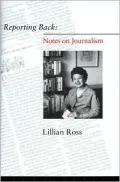
"For half a century, Lillian Ross has been writing remarkable and timeless journalism for The New Yorker. Her spirited, funny, factual short stories in The Talk of the Town and her unforgettable profiles and other long pieces have won her a legion of admirers. Many credit The New Yorker for the inventive, reportorial breakthroughs that have come to be called literary journalism, and Ross has been an integral part of its traditions. Her books Picture and Portrait of Hemingway were recently listed as two of the Twentieth Century's 100 best works of journalism, and Hemingway himself called Picture "much better than most novels."" With panache, wit, and her own inimitable style, Lillian Ross discusses the questions of what makes a good reporter and what constitutes good journalism. Her years of practicing the art have provided her with much to say about these questions and nowhere is this in better evidence than in her own work - the pieces and profiles long recognized and admired for their freshness, originality, sharpness, humor, and truth. Excerpted here, along with her own commentary, are such classics as "Come In, Lassie!" her first, never before republished piece on Hollywood; her profiles of Francis Coppola, Robin Williams, Adlai Stevenson, John Huston, and Tommy Lee Jones; her two portraits of the Miss America contest - the first one published in 1949, the second fifty years later; and many others.Editorials
Publishers Weekly
Ross (Here but Not Here) has written profiles and Talk of the Town pieces for the New Yorker for more than 50 years and in that time has built up an arsenal of journalistic techniques, which she shares here in some detail. In a matter-of-fact style that's never pedantic, she discusses her feelings about journalism, praising her New Yorker colleagues (notably the late editor William Shawn) and offering her definition of journalism (factual reporting built of good writing and singular humor). The majority of the book is filled with Ross's deconstruction of some of her best-loved pieces, including 1949's Come In, Lassie! (about politics in the film business); 1950's How Do You Like It Now, Gentlemen? (a profile of Ernest Hemingway); and 1960's The Yellow Bus (concerning a group of tourists visiting New York City). Through her analyses, various methods and principles come to light. For example, Ross believes that a journalist must possess self-confidence and a passion for life. She firmly believes that a tape recorder hinders reporting, and even reveals her preferred notebook (it's a 3-x-5 spiral-bound). Ross says she only writes about people, situations and events that appeal to her; she doesn't write about anyone who doesn't want her to, and she steers clear of ambiguous writing, favoring clarity and simplicity. Indeed, Ross's writing whether about a former president or an Upper East Side teenager is a testimony to refined, literary journalism. Equal parts memoir and writing lesson, Ross's book will be a boon to students and veteran New Yorker readers alike. (June 1) Copyright 2002 Cahners Business Information.Library Journal
For more than 50 years, Ross has written feature stories for The New Yorker that have won her many admirers. In this collection of analytical essays, Ross explains what makes her writing effective and discusses what makes a good reporter. Continuing in the self-revelatory vein of Here but Not Here (1998), a memoir about her days at The New Yorker and her relationship with legendary editor William Shawn, she intersperses lengthy excerpts from her "Profiles" and "Talk of the Town" pieces with autobiographical details, personal observations, and commentary on technique ("All elements are revealed with facts, quotes and actions"; "Humor is often what makes my stories into stories"). Most of the 28 essays, arranged in no apparent order, concern Ross's relationships with celebrities; she makes no secret of her admiration for these subjects, explaining that she can write only about people she likes. An odd hybrid of memoir, textbook, and anthology, this book ultimately fails to satisfy on all three counts. However, it may prove instructive to those who seek to emulate Ross's legendary fly-on-the-wall technique. An optional purchase for journalism collections. Susan M. Colowick, North Olympic Lib. Syst., Port Angeles, WA Copyright 2002 Cahners Business Information.Booknews
writer Lillian Ross has long been a part of the growth of literary journalism. Here she discusses her career of journalistically profiling writers, artists, musicians, playwrights, film directors, politicians, and other public figures. Reprints of many of her pieces are presented alongside her commentary of what she was trying to accomplish. Annotation c. Book News, Inc., Portland, OR (booknews.com)Kirkus Reviews
With generous selections from a half-century’s work, veteran New Yorker reporter Ross (Here But Not Here, 1998, etc.) reflects on writing, celebrities, her career, friends, and family. The author waxes both didactic and nostalgic in this genial hybrid of a volume. Part anthology, part memoir, part reporter’s handbook, part stargazing, this neither challenges nor offends and for the most part instructs and delights. It begins with Ross’s tributes to her principal influences, including Turgenev, Salinger, Hemingway, editor William Shawn, and her older sister Helen, whom Ross thanks very early on—and in the last sentence. She discusses her professional habits and principles: never use a tape recorder, write as clearly as possible, select only subjects of personal interest, employ as much dialogue as possible. When it all falls together well, she states, “It’s sort of like having sex.” Ross declines to enter the debate about the “old” New Yorker vs. the “new”; she loved Old Guard (Shawn, Harold Ross—no relation), and she has flattering things to say about former and current editors Tina Brown and David Remnick. In fact, it’s hard to find a discouraging word anywhere. The author divides her text loosely, a happy decision that permits her to revisit old stories and old friends on her own terms. Thus we read about a wide variety of personalities, from Adlai Stevenson (whom she greatly admired) to Bill Clinton (“I loved him and let him know it”) to Robert Kennedy, John McEnroe, Benny Goodman, Norman Mailer, John and Anjelica Huston, Charlie Chaplin, Lorraine Hansberry, Sidney Poitier, the Redgraves, Robin Williams, Lorne Michaels, Francis Ford Coppola, and others. Most of the previouslypublished selections are short, and Ross provides interesting commentary about each piece and its subject. “Facts are wondrous things,” she concludes. “When you stick to them, no other writing can beat reporting.” A reminder that many fascinating folk reside on Memory Lane.Book Details
Published
May 16, 2002
Publisher
Counterpoint Press
Pages
304
Format
Hardcover
ISBN
9781582431093