
Join Books.org — it's free

World Literature, Fiction Subjects
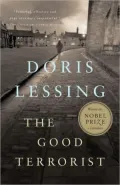
The Good Terrorist by Lessing, Doris May β€” book cover

The Good Terrorist

by Lessing, Doris May
Available on Bookshop Write a review

Books.org participates in affiliate programs including Bookshop.org and the Amazon Services LLC Associates Program. We may earn a commission from qualifying purchases made through links on this page, at no additional cost to you.

Log in to track your reading progress.

Overview

The Good Terrorist follows Alice Mellings, a woman who transforms her home into a headquarters for a group of radicals who plan to join the IRA. As Alice struggles to bridge her ideology and her bourgeois upbringing, her companions encounter unexpected challenges in their quest to incite social change against complacency and capitalism. With a nuanced sense of the intersections between the personal and the political, Nobel laureate Doris Lessing creates in The Good Terrorist a compelling portrait of domesticity and rebellion.

About the Author, Lessing, Doris May

Doris Lessing was born of British parents in Persia, in 1919, and moved with her family to Southern Rhodesia when she was five years old. She went to England in 1949 and has lived there ever since. She is the author of more than thirty booksβ€”novels, stories, reportage, poems, and plays. In 2007, she was awarded the Nobel Prize in Literature.

Biography

"Doris Lessing is the kind of writer who has followers, not just readers," Lesley Hazleton once observed. But the Nobel Prize-winning Lessing, whose classic novel The Golden Notebook was embraced as a feminist icon, has seldom told her followers exactly what they wanted to hear. For much of her career, she has frustrated readers' expectations and thwarted would-be experts on her work, penning everything from traditional narratives to postmodern novels to mystic fables.

Lessing was born in Persia (now Iran) and grew up in Southern Rhodesia (now Zimbabwe), where her father made an unsuccessful attempt to farm maize. Though she loved living on the farm, her family life was often tense and unhappy. Lessing married at the age of 20, but three years later, feeling stifled by colonial life and increasingly distressed by the racism of her society, she joined the Communist Party, "because they were the only people I had ever met who fought the color bar in their lives."

Soon after that, she left her husband and first two children to marry fellow Communist Gottfried Lessing, with whom she had a son. They divorced, and she took her son with her to England, where she published her first novel, The Grass Is Singing, to high acclaim. After several more novels, including the semi-autobiographical series Children of Violence, Lessing wrote The Golden Notebook, a postmodern, fragmentary narrative about a writer's search for identity. The Golden Notebook gained a passionate following in the feminist movement and "left its mark upon the ideas and feelings of a whole generation of women," as Elizabeth Hardwick wrote.

To Lessing's dismay, she was frequently cited as a "feminist writer" after that. Yet as Diane Johnson pointed out in a 1978 review of Stories, Lessing "also understands men, politics, social class, striving, religion, loneliness and lust." Johnson added: "Mrs. Lessing is the great realist writer of our time, in the tradition of the major Continental novelists of the 19th century, particularly Stendhal and Balzac, but also Turgenev and Chekhov -- a masculine tradition with which she shares large moral concerns, an earnest and affirmative view of human nature, and a dead-eye for social types."

But Lessing, who once called realist fiction "the highest form of prose writing," soon launched into a science-fiction series, Canopus in Argos: Archives, which baffled many of her fans. Lessing used the term "space fiction" for the series, which recounts human history from the points of view of various extraterrestrial beings. Though Lessing gained some new readers with her Canopus series, her early admirers were relieved when she came back to Earth in The Fifth Child, the story of a monstrous child born to ordinary suburban parents, which Carolyn Kizer deemed "a minor classic." Later novels like Mara and Dann included elements of fantasy and science fiction, but recently, with the publication of The Sweetest Dream, Lessing has returned to domestic fiction in the realist mode, which many critics still see as her best form.

Throughout her life, Lessing has been drawn to systems for improving human experience -- first Marxism, then the psychiatry of R. D. Laing, then Sufi mysticism. But her yearning for a single, transcendent truth coexists with a sharp awareness of the contradictory mix of vanities, passions, and aggressions that make up most human lives. As Margaret Drabble noted, Lessing is "one of the very few novelists who have refused to believe that the world is too complicated to understand."

Good To Know

Lessing's African stories painted a grim picture of white colonialism and the oppression of black Africans, and in 1956, Lessing was declared a prohibited alien in South Africa and Southern Rhodesia. In 1995, she was able to visit her daughter and grandchildren in South Africa, where her works are now acclaimed for the same content that was once condemned.

Though she was briefly allied with the Communist Party in Salisbury, Lessing has frequently insisted that the picture of her as a political activist is exaggerated. "I am always being described as having views that I never had in my life," she once told the Guardian. She has, however, been an outspoken critic of the racial politics of South Africa, and she once turned down the chance to become a Dame of the British Empire on the grounds that there is no British Empire.

To demonstrate how difficult it is for new writers to get published, Lessing sent a manuscript to her publishers under the pseudonym Jane Somers. Her British publisher turned it down, as did several other prominent publishers (though her American editor detected the ruse and accepted the book). The Diary of a Good Neighbour was published as the work of Jane Somers, to little fanfare and mixed critical reviews. Lessing followed it with a sequel, If the Old Could..., before revealing her identity as the author of both.

Reviews

There are no reviews yet. Log in to write one.

Editorials

Publishers Weekly - Publisher's Weekly

Lessing (The Golden Notebook, etc.) offers a bleak analysis of a decaying world in this tale about a group of British radicals who get mixed up in terrorist activities far beyond their level of competence. PW commented that the ``compulsively readable story . . . vividly displays the full array of Lessing's superb gifts as a traditional writer.'' (October)

Library Journal

Alice Mellings is the ``good'' terrorist, a sort of housemother for a group of London radicals who take over an abandoned and badly vandalized house as communal home and headquarters. Picketing with trade unionists and spray-painting bridges with slogans protesting vivisection, chemicals in food, Trident, and sexism, these small-time revolutionaries get involved in something big, and very dangerous, as the story progresses. Alice, whose contempt for her mother's middle-class values informs her rebellion, winds up just like her mother, decorating the squatters' squalid home and cooking for her comrades. A novel about home, family, and revolt on several levels, The Good Terrorist is good Lessing, sophisticated and ironicher first novel in some years that is not part of the ``Canopus in Argos'' series. Janet Wiehe, P.L. of Cincinnati & Hamilton Cty .

Library Journal

The Good Terrorist is the story of a loose-knit group of political vagabonds who move about London, living off the dole and existing as squatters in abandoned or condemned houses. Alice Mellings, the central figure in this tale, acts as a housemother to her fellow comrades, bringing curtains stolen from her own mother, cooking soup, carrying out trash, and finagling hot water and electricity for their comfort. Her efforts go largely unappreciated, however, for the others are more interested in radical political actions, such as bombing and being recruited by the IRA. Even though Alice never truly articulates her own political convictions, she becomes a willing partner in a terrorist act that seals her fate as a dysfunctional, drifting adult. Lessing portrays terrorism as psychopathological rather than political and thereby creates a chilling, strangely compelling story--one that will haunt listeners for quite some time. Unfortunately, Nadia May's nasal quality does not enhance the listening experience, and character transitions are difficult to follow until the story casts its darkly hypnotic spell, which happens by the end of the first tape. After that, the listener becomes used to May's voice and is held captive until the work's abrupt end. Despite these few drawbacks, this audiotape is essential for all literature collections; highly recommended for all popular fiction fans.--Gloria Maxwell, Penn Valley Community Coll., Kansas City, MO Copyright 1999 Cahners Business Information.

Book Details

Published
June 8, 2026
Publisher
Knopf Doubleday Publishing Group
Pages
384
Format
Paperback
ISBN
9780307389961

More by Lessing, Doris May

Similar books