
Children - Fiction & Literature
Available on Bookshop
Write a review
Books.org participates in affiliate programs including Bookshop.org and the Amazon Services LLC Associates Program. We may earn a commission from qualifying purchases made through links on this page, at no additional cost to you.
Log in to track your reading progress.
Synopsis
This powerful story, inspired by the life of a Holocaust survivor, is a testament to the human spirit and the transcendent power of music.When the Nazis invaded Poland, a family is split apart. The parents are sent to one concentration camp, their son to another. Only his father's gift, a harmonica, keeps the boy's hopes alive and, miraculously, ensures his survival. When an officer discovers his talent, he makes the boy play each night. Through music the boy invokes his parents and brings comfort to the other prisoners, lifting their spirits if only for a moment at time.
Ron Mazellan's luminous artwork depicts the bleakness of the time, while letting the beauty that hope can bring through the darkness shine.
Editorials
Publishers Weekly
Set in WWII Poland and inspired by a true story of a Jewish family, Johnston's (Uncle Rain Cloud) stirring tale opens on a wistful note: "I cannot remember/ my father's face,/ or my mother's,/ but I remember their love,/ warm and enfolding/ as a song." Mazellan's lifelike, earth-toned mixed-media paintings reveal a boy and his parents, first huddled together over a book, then singing together, then listening to the music of Schubert coming from a neighbor's gramophone. When his father returns from his job in a coal mine with a harmonica and gives it to the boy, his son practices on it until he can play Schubert. Meanwhile, "Somewhere outside, a war/ was raging. But it was far away-/ a bad dream-leaving us untouched." But not for long. The tenor of the narrative changes abruptly as Mazellan depicts Nazi soldiers banging on the door; the family is separated and the boy is sent to a concentration camp. When the commandant insists the lad play his harmonica for him each night, the boy cannot imagine how someone so cruel could appreciate the beauty of Schubert's music and is disgusted to perform it for him. But he finds solace in the realization that his playing also reaches his fellow prisoners, "who might hear the notes/ and be lifted, like flights/ of birds." The illustrator makes an affecting children's book debut, choosing images that communicate the story's pathos while sparing the audience many of the setting's horrors. Ages 6-11. (Feb.) Copyright 2004 Reed Business Information.Children's Literature
The true story of Holocaust survivor Henryk Rosmaryn is the inspiration for this stark, simply told, but emotion-packed narrative. As a young boy in Poland, our narrator's life was filled with family love and with music. Too poor to own a piano, they sang and listened to the gramophone. The father's precious gift to his son is a harmonica, which brings more music and joy to their lives. But the Nazis arrive and the boy is taken alone to a concentration camp. There he is asked to play his harmonica for the commandant. Guilty about receiving bread for his playing, he is reassured by the other prisoners that his music lifts their hearts. Despite the grim setting, Rosmaryn' survival in the United States until 2001 lets hope shines through the darkness. The text is a tone poem; the textured mixed-media illustrations reflect the camp setting in somber tones of brown, gray, and green following the warm tans and orange of the time when the family is free. The almost too naturalistic scenes of horror and pointless cruelty contrast the striped prisoners' garb with the Nazi uniforms amid the chill winter snow and in the overcrowded bunks. As the boy plays for the others, a touch of orange hints at the hope the music brings. 2004, Charlesbridge, Ages 7 to 10.—Ken Marantz and Sylvia Marantz
School Library Journal
Gr 3-6-Inspired by the story of a Holocaust survivor, this exquisite picture book is poignant and powerful. Simple sentences charged with delicate word choices briefly recount the first-person narration of a poor but happy boy and his parents in Poland who were captured, split up, and taken to concentration camps. The youngster manages to take with him the harmonica his father gave him, on which he plays Schubert. The commandant of the camp learns of his talents and orders him to, "Play, Jew!" The boy complies-and finds out that the whole camp hears him and takes heart from the music. The mixed-media illustrations change from a warm to cold palette to underscore the move from home to camp. While the story is set in World War II, the theme is broader, and makes a case for the power of music/art to support and sustain humanity. There is an appended note about the life of Henryk Rosmaryn.-Cris Riedel, Ellis B. Hyde Elementary School, Dansville, NY Copyright 2004 Reed Business Information.Kirkus Reviews
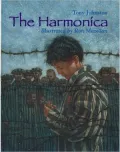
This dark piece is based on a Holocaust survivor's experience. A boy lives happily with his parents in Poland, singing and learning to play harmonica; however, the mixed-media illustrations already swirl with anguish and the barbed wire on the cover looms large. Sent to a concentration camp alone, he endures hunger, cold, and forced labor. In a painful twist, an officer discovers his musical gift: " 'Play, Jew!' The commandant spat, night after night." Tormented, the boy plays Schubert, wrestling with the question of how the beautiful music can both invoke his loving parents and also bring rapture to a murderous Nazi officer. One night in the dark barracks, a voice whispers, "Bless you": the Schubert has reached the ears of the prisoners as well. So in his heart, he plays for them-and for his gone-forever parents. Frequent figurative language gives the narrative voice an adult tone. Visually effective and grim. (author's note) (Picture book. 8+)Book Details
Published
July 1, 2008
Publisher
Charlesbridge Publishing, Inc.
Pages
32
Format
Paperback
ISBN
9781570914898