
Join Books.org — it's free

Legends, Myths & Fables - General & Miscellaneous, Fiction - Social Issues, Fiction - Fantasy & Magic, Fiction - Emotions & Behaviors
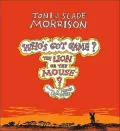
The Lion or the Mouse? by Toni Morrison, Slade Morrison, Pascal Lemaitre β€” book cover

The Lion or the Mouse?

by Toni Morrison, Slade Morrison, Pascal Lemaitre
Write a review
Log in to track your reading progress.

Overview

In this charmingly subversive reinterpretation of a classic tale, the Morrisons and Pascal Lemaitre take a hilarious look at bullying.

The cocky lion, the self-proclaimed "baddest in the land," believes himself invincible until he gets a thorn stuck in his paw. Only a weak little mouse can help him, but then the lion must indulge the mouse's ridiculous pride and appetite for power.

We, the creators of Who's Got Game?, were inspired by the wonder of Aesop's Fables -- their vitality, their endless demand for new interpretations. In our versions the original stories are opened and their moralistic endings reimagined: the victim might not lose; the timid gets a chance to become strong; the foool can gain insight; the powerful may lose their grip. ANYTHING CAN HAPPEN. More than a play on these beloved fables, Who's Got Game? is AESOP LIVE!

ALL AGES

Synopsis

Who's got game? The proud lion left helpless by a thorn in his paw or the meek mouse who rescues the big cat and appoints himself king of the jungle? In the Morrisons' rendition, the story's timeless moral is revitalized with a clever new spin.

About the Author, Toni Morrison, Slade Morrison, Pascal Lemaitre

Toni Morrison, who is best known for her fiction, teaches at Princeton University. Her novels include Song of Solomon (1977), Beloved(1987), Jazz(1992), Paradise(1998) and Love(2003).

Biography

Toni Morrison has been called "black America's best novelist," and her incredible string of imaginative contemporary classics would suggest that she is actually one of America's best novelists regardless of race. Be that as it may, it is indeed difficult to disconnect Morrison's work from racial issues, as they lie at the heart of her most enduring novels.

Growing up in Lorain, Ohio, a milieu Jet magazine described as "mixed and sometimes hostile," Morrison experienced racism firsthand. (When she was still a toddler, her home was set on fire with her family inside.) Yet, her father instilled in her a great sense of dignity, a cultural pride that would permeate her writing. She distinguished herself in school, graduating from Howard and Cornell Universities with bachelor's and master's degrees in English; in addition to her career as a writer, she has taught at several colleges and universities, lectured widely, and worked in publishing.

Morrison made her literary debut in 1970 with The Bluest Eye, the story of a lonely 11-year-old black girl who prays that God will turn her eyes blue, in the naΓ―ve belief that this transformation will change her miserable life. As the tale unfolds, her life does change, but in ways almost too tragic and devastating to contemplate. On its publication, the book received mixed reviews; but John Leonard of The New York Times recognized the brilliance of Morrison's writing, describing her prose as "...so precise, so faithful to speech and so charged with pain and wonder that the novel becomes poetry."

Over time, Morrison's talent became self-evident, and her reputation grew with each successive book. Her second novel, Sula, was nominated for a National Book Award; her third, 1977's Song of Solomon, established her as a true literary force. Shot through with the mythology and African-American folklore that informed Morrison's childhood in Ohio, this contemporary folktale is notable for its blending of supernatural and realistic elements. It was reviewed rapturously and went on win a National Book Critics Circle Award.

The culmination of Morrison's storytelling skills, and the book most often considered her masterpiece, is Beloved. Published in 1987 and inspired by an incident from history, this post-Civil War ghost story tells the story of Sethe, a former runaway slave who murdered her baby daughter rather than condemn her to a life of slavery. Now, 18 years later, Sethe and her family are haunted by the spirit of the dead child. Heartbreaking and harrowing, Beloved grapples with mythic themes of love and loss, family and freedom, grief and guilt, while excavating the tragic, shameful legacy of slavery. The novel so moved Morrison's literary peers that 48 of them signed an open letter published in The New York Times, demanding that she be recognized for this towering achievement. The book went on to win the Pulitzer Prize; and in 2006, it was selected by The New York Times as the single best work of American fiction published in the last 25 years.

In addition to her extraordinary novels, Morrison has also written a play, short stories, a children's book, and copious nonfiction, including essays, reviews, and literary and social criticism. While she has made her name by addressing important African-American themes, her narrative power and epic sweep have won her a wide and diverse audience. She cannot be dismissed as a "black writer" any more than we can shoehorn Faulkner's fiction into "southern literature." Fittingly, she received the Nobel Prize in 1993; perhaps the true power of her impressive body of work is best summed up in the Swedish Academy's citation, which reads: "To Toni Morrison, who, in novels characterized by visionary force and poetic import, gives life to an essential aspect of American reality."

Good To Know

Chloe Anthony Wofford chose to publish her first novel under the name Toni Morrison because she believed that Toni was easier to pronounce than Chloe. Morrison later regretted assuming the nom de plume.

In 1986, the first production of Morrison's sole play Dreaming Emmett was staged. The play was based on the story of Emmett Till, a black teen murdered by racists in 1955.

Morrison's prestigious status is not limited to her revered novels or her multitude of awards. She also holds a chair at Princeton University.

Reviews

There are no reviews yet. Log in to write one.

Editorials

Publishers Weekly

A boastful king of beasts gets a thorn in his paw and lets a timid mouse pull it. Afterward, the two reverse roles; the lion learns humility, but the mouse becomes a power-mad bully. Once again the audience must decide "who's got game," or who's in the right. Both retellings-especially the shrewd portrait of the musician-score slam dunks. All ages. (June) Copyright 2003 Reed Business Information.

Children's Literature

What can a lion do when a thorn is in his paw? Who can help him to get it out? The elephant? The monkey? The mouse? This book is an adaptation of one of Aesop's classic fables of the Lion and the mouse. The entire story is written in prose. The text is easy to speak and fun to listen to because of the alliteration. The book did have one problem: the words were difficult to read because the font used looks like someone's handwriting rather than an easily readable font. The handwriting also makes the book look less appealing and professional. The pictures and storyline are done in cartoon style with the text accompanying the individual pictures. The design for the graphics is well done and helps to describe the story of the book. As with most of Aesop's fables, the end of this story includes a very good moral. 2003, Simon & Schuster, Ages 5 to 12.
β€” Nicole Peterson

School Library Journal

Gr 2-5-The Morrisons extend Aesop's "Lion and the Mouse" into a hip-hop-cadenced meditation on bullying, with some role reversal. "LISTEN UP! LISTEN UP! NO IFS, MAYBES, ANDS, OR BUTS. I AM THE KING ALL OVER THE LAND. I DO WHAT I LIKE. I DO WHAT I CAN!" So roars Lion, until felled by a thorn, and Mouse squeaks a similar line, after putting Lion back on his feet. Outraged when all of the other animals only laugh, Mouse proceeds to pester Lion with complaints, until the larger animal quietly departs, leaving his house and throne to his erstwhile rescuer. Lema tre decks Lion out in a robe, places him in natural settings-except when the scene moves indoors-and supplies hand-lettered text and dialogue to go with the cartoon panels. After leaving Lion sitting alone asking, "Is he who wants to be a bully just scared to be himself?" the artist then closes with a puzzlingly disconnected sequence of frames involving the mouse, Lion's throne, and a buglike creature. Morrison's celebrity status may sell the book, but this patchy, illogical episode isn't likely to sell many readers on its lesson.-John Peters, New York Public Library Copyright 2003 Reed Business Information.

Book Details

Published
May 1, 2004
Publisher
Simon & Schuster
Pages
40
Format
Hardcover
ISBN
9780743222488

More by Toni Morrison, Slade Morrison, Pascal Lemaitre

Similar books